By: Dr. B.

It is likely that most of us have been experiencing high levels of stress lately. During the Coronavirus pandemic, many of our lives changed drastically in a matter of months. Many of us have had to adapt to new routines, have had a lack of access to the outside world, and have been staying at home for the most part, leading to toxic stress and trauma.
Now that we can start venturing out into the world again, many of us may feel excited (a change of scenery!), but we may also be experiencing some anxiety.
High Stress and the Brain

To help us adapt to these stressful life circumstances, our brains have undergone some changes. When we experience high levels of stress, the brain activates the fight or flight response, which results in the release of epinephrine and cortisol. When we experience chronic, or long-term stress, our brain is unable to recover from this state properly, which may result in extended activation of the sympathetic nervous system. This can cause us to feel anxious and as if we are constantly on “high alert”. These brain changes make it easier for us to become anxious, overwhelmed, and overstimulated.
Experiencing Anxiety

“I am so excited to go out to lunch! – I have barely left the house in months, only going out for groceries and the occasional errand.
I haven’t seen most of my friends or extended family in ages.
As I drive down 93, sitting next to my good friend who I picked up on the way, I am so happy to be out! The sun is shining, traffic is light, and I say to myself, ‘Boy, I haven’t been this far away from my house in more than 3 months.’
I look around and notice the leaves on the tree,
realizing that the last time I saw them they were bare.”

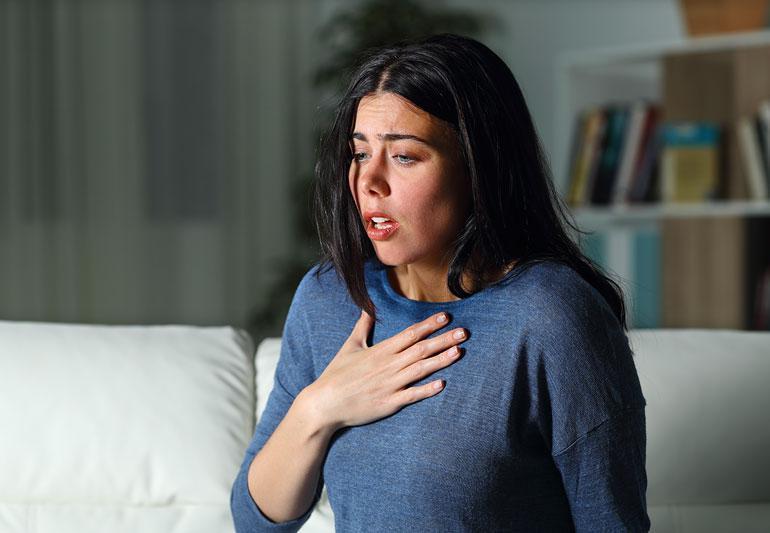
“Suddenly it becomes hard for me to take a breath, I feel warm, my head hurts and the sound of my friend’s voice becomes muffled. I think to myself ‘I am going to pass out, maybe I have Corona?’ I can’t take a deep breath, this mask is suffocating me, I have a headache, I need to pee. ‘Where will I pee?? I can’t stop anywhere!’”

My friend looks at me and says, “You okay?”
I try to take a breath through my nose and let it out slowly and I say, “Yeah, I haven’t been this far from home in a few months.” She responds, “Kinda scary, huh?” I nod and try to focus on my breathing and what she is talking about. I remind myself to smile as this sends a signal to the amygdala to not be triggered. My friend says “Yes, that happened to me when I first left my house.”
I try to remind myself of the techniques that can help.
- Parasympathetic breathing: Parasympathetic breathing helps the parasympathetic nervous system to activate, which helps us to relax. Parasympathetic breathing can be accomplished with extended exhalation through the nose and breathing out through the mouth.
- Smile: Smiling helps to keep the amygdala from triggering and sends a signal to the brain that you are safe.
- Body Posture: Maintaining a straight body posture (by aligning the head, neck and spine so that the chin is slightly tipped down and the eye gaze goes naturally down) helps to keep breathing slow and releases GABA neurotransmitters, which helps to counteract anxiety.
- Mindfulness: Mindfulness allows you to be aware of your physical and mental states and can help you to use more adaptive reactions to difficult situations.
“I am a visual/kinesthetic learner so what works best for me is focusing on the signs as we pass them on the read. I reach each sign I see and note the color. This allows me to single-focus for a moment, takes my mind off the anxiety I am experiencing, and helps to calm my anxious thoughts.”
When practicing mindfulness, it is helpful to tune into your personal learning style. If you are an auditory learner, you could focus on the sounds you hear around you. If you are a kinesthetic learner, you could try touching each finger to your thumb or you could gather things from your bag. You could also try to notice the scents around you or smell different things that you have with you (this could be quite entertaining for your friends!). If you have a drink or food with you could also take a sip or bite and close your eyes as you enjoy the taste and become aware of the differences.
- Visualization: Positive visualization helps you to focus on feelings of positivity which can help to calm anxious thoughts.
“I visualize a vacation or a favorite memory. As they say, ‘Go to your happy place’”
- Appreciation: Practicing appreciation also helps to focus on feelings of positivity, and can help to calm anxious thoughts.
“I try to remind myself about what I am appreciative for: I’m out of the house, on a beautiful day, with a loved one.”
- Connection: Connecting with others can help to increase feelings of security, happiness, and relaxation.
“I talk to my friend about what I am appreciative for or what my happy place is (I appreciate my happy place too).”
- Helping/Service: Helping others can decrease stress levels and minimize the impact of stress.
“I asked my friend about her experience when she got anxious about leaving the house and she shared her story with me. Then we went over strategies and techniques together.”
- Progressive Muscle Relaxation: Muscle relaxation exercises can help to reduce stress levels and can help your body and mind relax. Progressive muscle relaxation can be accomplished by tensing and then relaxing certain muscles in your body. Start with your neck, then your shoulders and then continue to the other muscles in your body.
- Repeat a mantra: Repeating a mantra helps to reduce levels of anxiety and increases positive mood, feelings of relaxation and focused attention. Try something like
“I am calm, cared for, and connected”
For More Tips and Strategies check out www.core-methods.com and www.thebehaviorbootcamp.com
References
Andre, C. (2019). Proper breathing brings better health. https://www.scientificamerican.com/article/proper-breathing-brings-better-health/#:~:text=You%20are%20under%20the%20influence,speeds%20up%20and%20becomes%20shallower.
Anxiety Canada. (2020). Progressive muscle relaxation. Fallon, A. (2020). Chanting. https://www.abc.net.au/news/2020-04-21/chanting-practice-reduce-symptoms-stress-anxiety-depression/12046736
Kind, S. (2020). Effects of mindfulness. https://www.anxiety.org/can-mindfulness-help-reduce-anxietySchultz, R. (2018).
Overcome anxiety with posture. https://furthermore.equinox.com/articles/2018/09/anxiety-posture

